
BRUSSELS — The European Commission will propose a €45 billion loan to Ukraine that it says would be repaid using future Russian war reparations, according to an internal document circulating among officials.
If Moscow refuses to pay reparations, “the Union reserves its right to make use of the Russian assets immobilised in the Union to repay the loan,” the document said. That way, Brussels argues, Ukraine never has to repay the loan, keeping its mounting debt sustainable after more than four years of war. The Commission plans to raise the money by issuing common EU debt, backed by the bloc’s budget.
EU leaders are set to discuss the loan when they meet in Brussels at the end of next week to finalise the bloc’s next seven-year budget and Kyiv’s financing needs.
The Commission will unveil what it calls the “Instrument for Coordinated Support to Ukraine” to cover roughly two-thirds of Ukraine’s estimated €70 billion financing gap for 2027, although payouts could stretch out until the end of 2028. Brussels is hoping the remaining third will be covered by international allies, especially Canada, Japan, the U.S., and the U.K.
The next EU budget itself could also help cover the borrowing costs of the loan, which will be conditional on reforms that Ukraine must complete to secure the payouts, the document added.
The new financial instrument echoes many elements of the previous large loan plans, including references to using war reparations or frozen Russian assets to repay the debt. Leaders had earlier discussed leveraging frozen Russian state assets to finance Ukraine’s defense, but those talks stalled amid resistance from some member states.
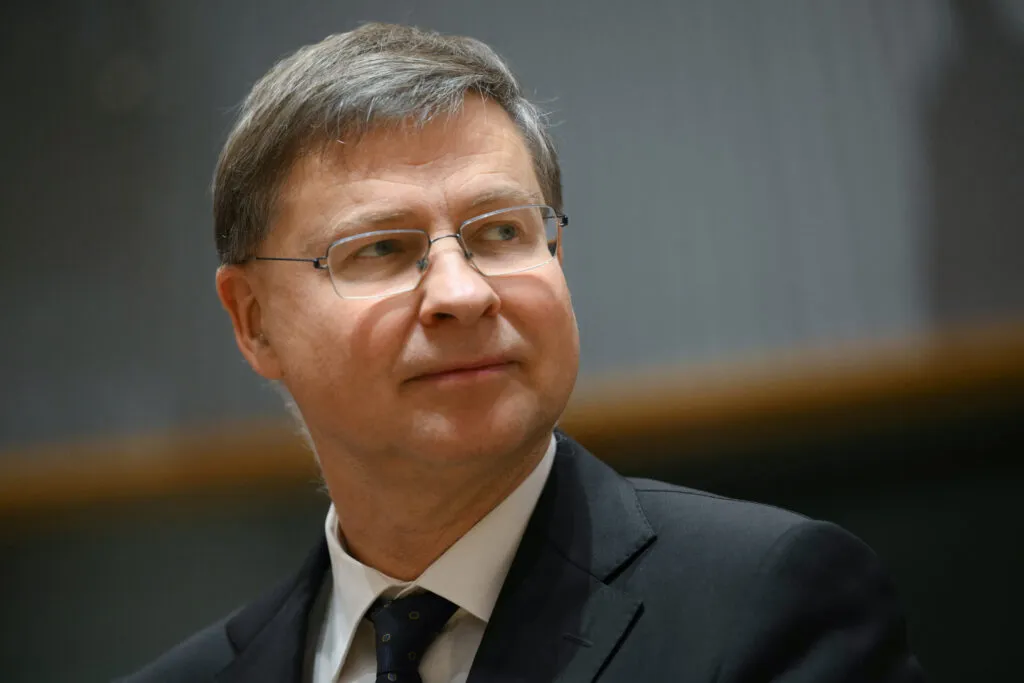
Valdis Dombrovskis attending a meeting of the Eurogroup in Brussels on Nov. 9, 2026. | Nicolas Tucat/AFP via Getty Images
This time, the Commission wants no carve-outs for Czechia, Hungary, and Slovakia.
“We are putting the emphasis of importance of ensuring that it is all 27 EU Member States which are contributing to this program, not 24, as it is right now,” Economy Commissioner Valdis Dombrovskis told reporters on the margins of a recent EU growth forecast briefing.
The document also suggested new measures that could trigger fresh loans from G7 countries, to be eventually “repaid from future flows of extraordinary revenues stemming from the immobilisation of Russian sovereign assets.”
Other provisions would allow foreign countries with high creditworthiness to provide financial guarantees to the EU that could mobilize another €5 billion in loans.
Controversy ahead
The reference to Russian assets revives the contentious debate over whether frozen assets should be used, since it remains unlikely that Moscow will voluntarily compensate Ukraine.
Most of the roughly €210 billion worth of frozen Russian assets in the EU are held in the Brussels-based financial depository Euroclear. When their use was last debated, some leaders demanded unlimited financial guarantees to guard against the risk that using the assets would provoke harsh Russian retaliation at home and abroad.
Despite repeated calls from some capitals and MEPs to leverage the frozen assets, Commission President Ursula von der Leyen opted for another loan mechanism to try to secure quick agreement among member states.
That is not to say the initiative will sail through. Czechia, Hungary, and Slovakia have already said they do not want to participate. Their stance drew sharp criticism from German Chancellor Friedrich Merz, who warned that refusing to join could weaken their negotiating position in the next round of EU budget talks.
Supporting Ukraine, Merz argued at a recent press event with Hungarian leaders, “is a shared European responsibility, not the responsibility of individual member states. That is why the question of how we will finance Ukraine in the coming years, if necessary, naturally belongs within the context of these budget negotiations.”