
EU and Canada seize a brief chance to shield ties from Trump’s swings Brussels and Ottawa are pushing for a major upgrade in their relationship while the U.S. president is distracted by the midterms — and before European politics shift. By SEBASTIAN STARCEVIC Illustration credit
The EU and Canada are betting they can deepen their partnership while Donald Trump looks inward at the U.S. midterms — and before European elections upend the political calculus.
Their strategy is to press for the broadest possible upgrade and hope Trump is too busy campaigning to retaliate, four EU officials and two Canadian diplomats familiar with preparations for this week’s summit in Montreal said.
Trump, whose Republican Party is fighting to retain control of Congress in next week’s midterms, has dismissed the EU’s offer of associate membership for Canada as “laughable” and threatened “serious tariffs” if the two sides grow too close. But many here see his threats as performative — risky, certainly, but not necessarily decisive if Europe and Canada move with purpose.
European Commission President Ursula von der Leyen and European Council President António Costa will join Canadian Prime Minister Mark Carney for two days of talks on trade, security, energy, education and the Arctic on Thursday.
The summit “is a very strong statement,” said Mark Camilleri, president of the Canada and EU Trade and Investment Association. “I don’t think there’s any feeling that this is going to be some discreet get-together.”
Canada is also trying to act before Europe’s politics shift. Ottawa wants durable changes to the partnership that will outlast Trump and any future nationalist surge in France, said a Canadian diplomat. All the officials and diplomats quoted here spoke on condition of anonymity to describe the summit preparations frankly.
Avoiding Trump’s ire
Brussels and Ottawa are pushing to strengthen their relationship, including through closer cooperation on trade and defense, international engagement and institutional links, according to a draft joint statement reviewed by reporters.
In her September State of the Union speech, von der Leyen stressed that the EU-Canada alliance is “not against anyone else.” Still, officials recognize that a stronger alliance could draw the ire of Trump.
Von der Leyen, Costa and Carney “are fully aware that the eyes of the world are upon them,” Camilleri said.
“The U.S. is watching,” a senior EU official added, yet the bloc and Canada are proceeding with business as usual and pushing for the most expansive possible relationship with Ottawa. Many here argue that Europe should not be treated as merely responsive to U.S. moods and that a confident EU-Canada axis could help rebalance ties in a tense global environment — including by keeping open pragmatic engagement with other partners.
Another possibility is that the summit produces only “nice pictures” and little substance, a third senior official cautioned, which could make it less likely to “trigger” the president.
European capitals, EU institutions and Canada’s provinces are all waiting to see what von der Leyen and Carney agree on in their meeting, the Canadian diplomat said, adding it was impossible to pre-judge how Trump would react.
Shadow of Le Pen
Ottawa also faces pressure from Europe’s electoral calendar and the growth of the far right.
With Spain, France, Poland and Italy all set to vote in the coming year, Canadian officials want to lock in concrete gains while EU governments remain receptive to closer cooperation, before elections across the bloc shift priorities and upset the political balance.
When Carney came to Strasbourg to set out his vision for a closer alliance in September, he was heckled from the gallery by an Alternative for Germany MEP who led chants of “USA!”
But it’s France’s presidential election in April — and the prospect of a Le Pen victory — that alarms Ottawa most, according to a second Canadian diplomat.
“It’s very fortunate we’re doing this summit now and not in six months,” the diplomat said, referring to the French election date.
Canada is pushing for big, bold “structural changes” in its relationship with the EU now that will outlast Trump and any future nationalist leaders, the diplomat added. Carney has grasped the rarity and urgency of the moment and is determined not to leave the summit without securing major wins, the first Canadian diplomat said.
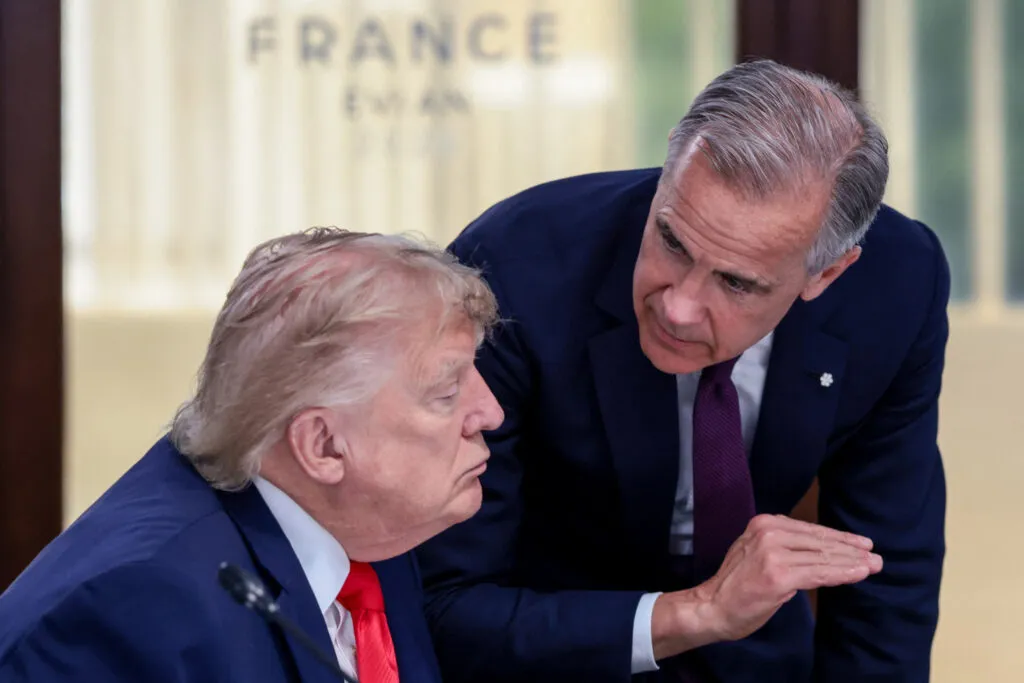
U.S. President Donald Trump and Canada’s PM Mark Carney at a G7 summit in France on June 16, 2026. | Pool photo by Evelyn Hockstein via Getty Images
Another question is whether Brussels and Ottawa can upgrade their partnership without eventually drawing the U.S. president’s ire. The midterms might buy them some time, but the vote will not keep Trump busy forever.
Trump could be even more dangerous and more likely to lash out at the EU and Canada after the election, since he would retain many tariff and foreign policy tools even if Republicans lose Congress, the second Canadian diplomat warned.
“At the end of the day, his reaction could be anything,” Camilleri said. “We can only control what we can control.”
Mathieu Pollet contributed reporting.