
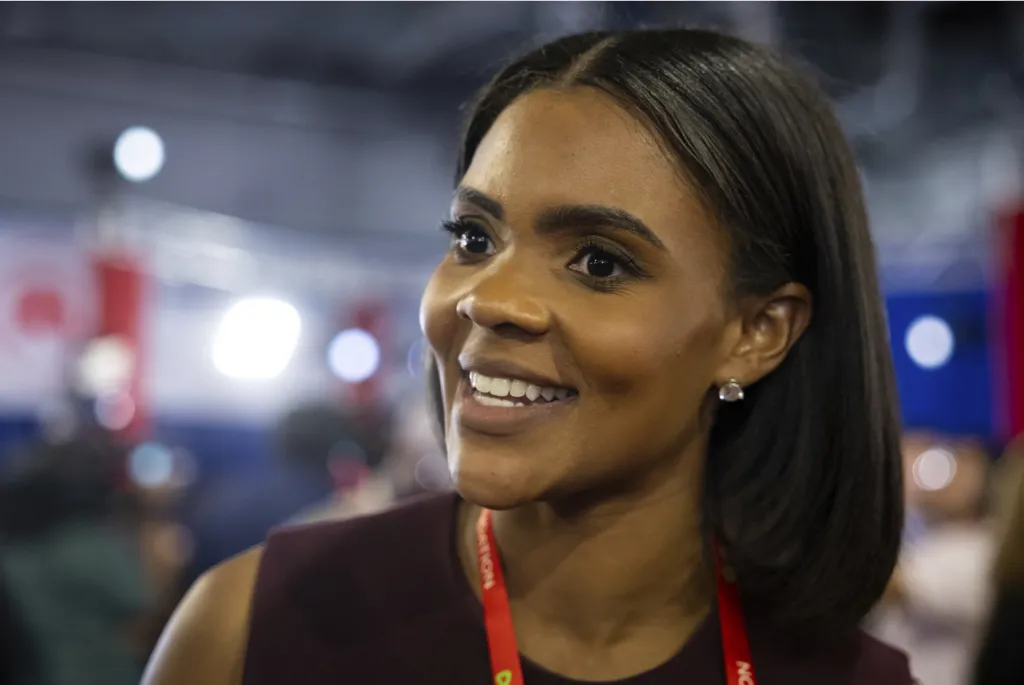
How conspiracy influencer Candace Owens turned the Brigitte Macron hoax into a global spectacle The American turned this conspiracy theory into a podcast with over 30 million views. She now finds herself at the centre of an unprecedented legal fight brought by the Macron couple. By MARION SOLLETTY in Paris Right‑wing American influencer Candace Owens is being sued by the Macron couple for spreading “devastating lies”**. | Francis Chung.
This story is also available in English.
Xavier Poussard didn’t arrive in Nashville empty‑handed. When he landed in Tennessee on 20 January 2025, the journalist carried what he later called “a gold mine” — the manuscript of his book, Becoming Brigitte, a 340‑page self‑published work that promotes what is in reality a sweeping conspiracy theory: the false claim that Brigitte Macron, France’s first lady, was born male.
Poussard came to discuss the project with Candace Owens. The American right‑wing influencer, a former Trump supporter turned podcaster, had contacted him with the idea of turning his research into a worldwide phenomenon.
Owens had already covered the story on her YouTube channel, one of the most watched podcasts globally, and had noticed her audience’s appetite for the tale, Poussard later said to a US outlet. She was ready to scale it up.
The pairing was unlikely but complementary. Poussard — awkward on camera, a bespectacled intellectual — put the theory’s details on paper in a dense, dizzying style. Owens, media‑savvy and with a vast following on YouTube, brought the community and production know‑how to give the story global reach. According to Poussard, she even suggested borrowing the title and visual identity from Michelle Obama’s Becoming for the project.
Three weeks after their meetings, the French author published Becoming Brigitte (Devenir Brigitte in French), a self‑published book “presented” by Candace Owens. At the same time Owens released an eight‑episode video series on her channel that has now surpassed 30 million views. Poussard declined to give exact sales figures but said the book sold between 50,000 and 100,000 copies — numbers he had not previously disclosed.
The problem for the story is simple: it is false. Brigitte Macron and her husband, the French president, decided to take legal action. In a 250‑page complaint filed in Delaware, they accuse Candace Owens of spreading “extravagant, defamatory and fanciful” narratives and “devastating lies” about the Macrons that could be easily verified.
The July 2025 lawsuits, widely publicised, marked a fresh stage in the couple’s fight against a conspiracy that began in the shadows in France in 2018 and later gained a broader audience across the Atlantic through far‑right media channels.
The case against Owens and the related French procedures reveal how a successful conspiracy theory travels — from the depths of the French internet to YouTube channels with global reach. It also shows the limits of power in the age of social networks, where even the world’s most powerful people struggle to stop the spread of fake news, and where attention converts quickly into profit for the most extreme theories.
Birth of a conspiracy theory
10 December 2021. From her apartment in Angers, medium and aspiring influencer Amandine Roy presents a special guest to her modest YouTube audience. Nathalie Rey, 51, had spent three years trying to expose what she believes is a large‑scale hoax involving France’s first lady.
Amandine Roy, real name Delphine Jegousse, bills herself as a “medium, whistleblower and journalist.” She has bleached hair and large hoop earrings. Her activities range from fortune‑telling consultations — including a five‑session course called the “crystal skull workshop” — to what she calls “authentic information.” From her makeshift studio, she launches the interview while Nathalie Rey, connected remotely, struggles with her iPhone.
Nathalie Rey, who speaks off camera under the pseudonym “Natacha,” refuses to show her face. Her thesis: the official story of Brigitte Macron’s life is a lie. She claims the first lady is actually her brother, Jean‑Michel Trogneux, who supposedly transitioned to become a woman — despite photographs of the two together at Emmanuel Macron’s 2017 and 2022 inauguration ceremonies.
Rey’s case rests largely on Brigitte Macron’s appearance. “Her strange looks have bothered me from the start,” she says early in the video, and points to alleged anomalies in the first lady’s family history.
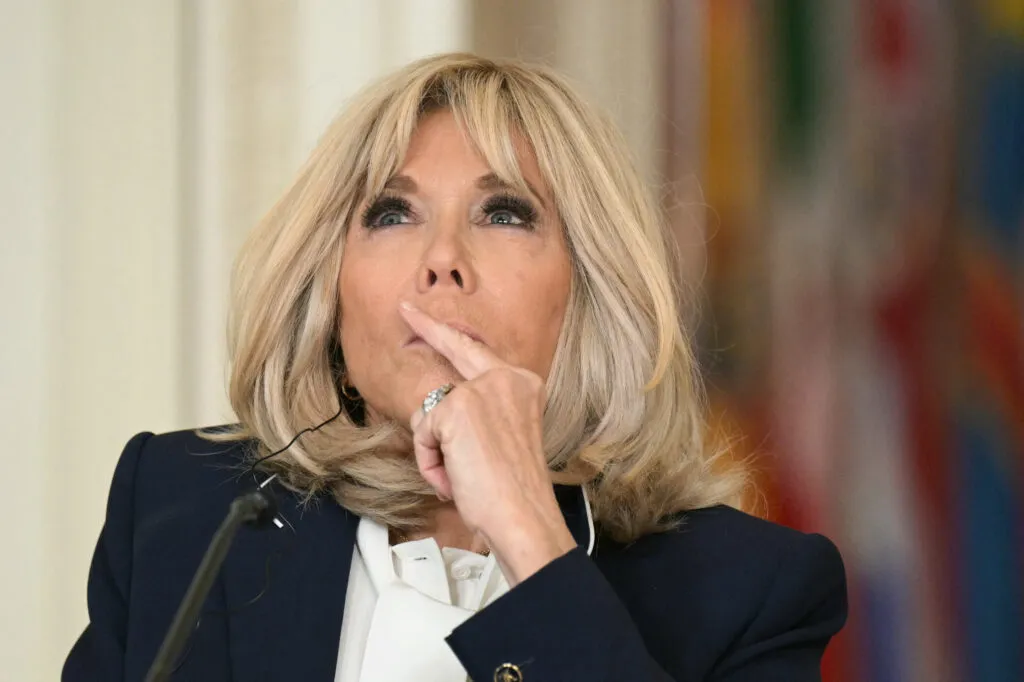
Brigitte Macron wants her legal battle to be an example in the fight against harassment. | Oliver Contreras /AFP via Getty Images
Rey began probing Brigitte Macron’s life in 2018 after losing her job. Her growing doubts about the couple’s official biography became her main preoccupation. A former Yellow Vest sympathiser, Rey’s distrust of political elites intensified during social isolation and hours online during the Covid pandemic, according to journalist Emmanuelle Anizon in L’Affaire Madame (StudioFact, 2024).
Rey was driven by a belief that the rich and powerful operate with impunity — a view that led her to follow the Jeffrey Epstein story closely.
For three years she pursued her small investigation, but most journalists showed little interest — except Xavier Poussard. He had begun working on the topic for Faits et Documents, a far‑right publication with links to Alain Soral, and he put Rey’s suspicions into writing, adding his own research and storytelling. In 2021 he produced a series of speculative articles full of “what ifs.” He argued that the alleged truth about Brigitte Macron was just the tip of the iceberg, and suggested the media had covered up both the first lady’s past and an alleged grooming of Emmanuel Macron by his future teacher, describing the Macrons as a “perverse couple.”
Poussard’s sensational pieces reached a small far‑right audience until Amandine Roy’s YouTube video brought the story to a much wider public.
In her four‑hour show, Rey attacked the “political caste” and “manipulative propagandist media.” She and Roy claimed journalists were either complicit or silenced by threats.
Within days the video hit 500,000 views and the hashtag #JeanMichelTrogneux trended in Twitter’s top 10. What began as one woman’s obsession was turning viral.
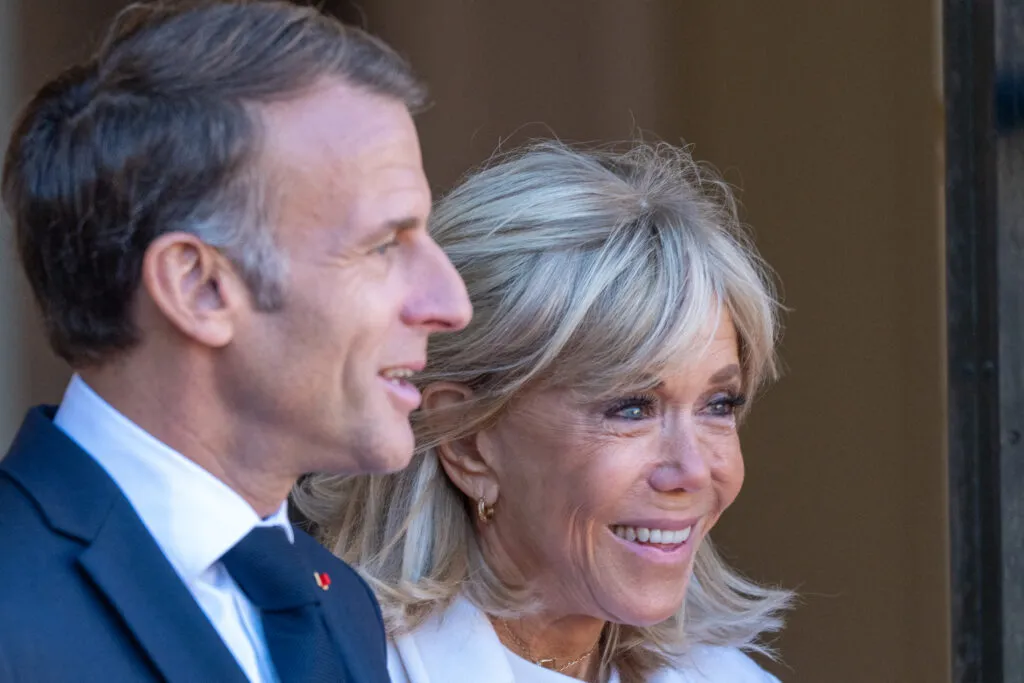
Brigitte Macron filed an initial complaint in January 2022. | Henrique Campos/Hans Lucas/AFP via Getty Images
And the first lady took notice.
Streisand effect
Brigitte Macron acted quickly. Less than a week after the video went viral, her lawyer said she intended to sue those behind the misinformation. Weeks later she appeared on TF1 to address the controversy.
“Obviously it’s a lie,” Brigitte Macron said, also discussing her long fight against cyberharassment. “I fear the violence… I fear the hatred… I fear this permanent crescendo.” She framed her legal move as a matter of principle and of years‑long engagement for stronger social‑media regulation to curb cyberharassment.
But the legal push fed conspiracy believers, who treated the Macrons’ counterattack as proof of something to hide.
Years later the dynamic repeated with the US lawsuit against Candace Owens, which is still in its early phases.
“The engine of the affair is Brigitte Macron,” Poussard said. “She’s a boomer who doesn’t control the Streisand effect.”
The Streisand effect describes how attempts to silence misinformation often amplify it. Mike Borowski, host of an alternative talk show and a major relay of the theory in France, says that is exactly what happened: “They created the buzz,” he told a US outlet. “Without the Macrons’ interventions, it would have stayed an internet story.”
“Everything comes out”
By the time Becoming Brigitte appeared, the Macrons had already spent more than three years fighting the conspiracy.
The first defamation suit was filed in January 2022 by Brigitte Macron and her brother, Jean‑Michel Trogneux, against Nathalie Rey and Amandine Roy, the two women behind the viral video.
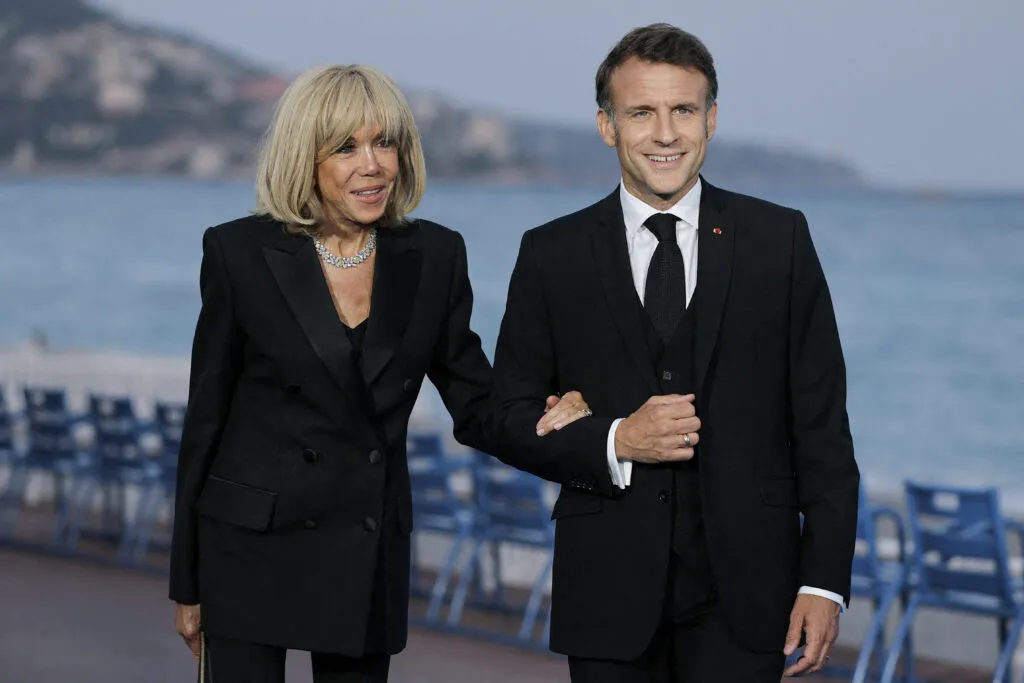
Emmanuel Macron described the disinformation campaign as one of the worst political experiences of his life. | Christian Hartmann/Pool/AFP via Getty Images
French authorities also pursued cyberharassment charges against people accused of spreading malicious claims about the first lady. Poussard, who lives in Italy, was questioned by police in that context but has not been charged.
For the Macrons, the allegations hit a sensitive chapter of their personal history: the origins of their relationship. Emmanuel met Brigitte when he was in high school in Amiens; she was 24 years his senior and married. The couple’s early relationship caused family upheaval and ended Brigitte’s first marriage to André‑Louis Auzière, who has since died.
Tiphaine Auzière, the first lady’s daughter, described that period as painful for the family and observed that in a small provincial town “everything comes out.” The Macrons have shared only carefully chosen details about those years, and conspiracy adherents filled the gaps by dissecting childhood photos and comparing ears and facial features. Poussard’s book even includes a visual analysis using a Chinese facial‑recognition tool to chart supposed changes in Brigitte Macron’s features over time.
“That’s what defines conspiracy theories: they make something out of nothing,” said prominent lawyer and politician Eric Dupond‑Moretti, who was justice minister when the allegations surfaced.
Tiphaine Auzière testified in one French trial about the toll the claims took on her mother: “She has to be careful about what she wears and how she poses because her image can be misused.”
Posts promoting the theory often feature close‑ups of the first lady’s body, speculating about her silhouette and movements. A politician close to the couple, speaking anonymously, said the family has been deeply wounded.
Freedom of expression
In January 2026, a Paris court convicted ten people, including Amandine Roy, of cyberharassment for relaying malicious claims about Brigitte Macron; sentences ranged from awareness courses to suspended prison terms.
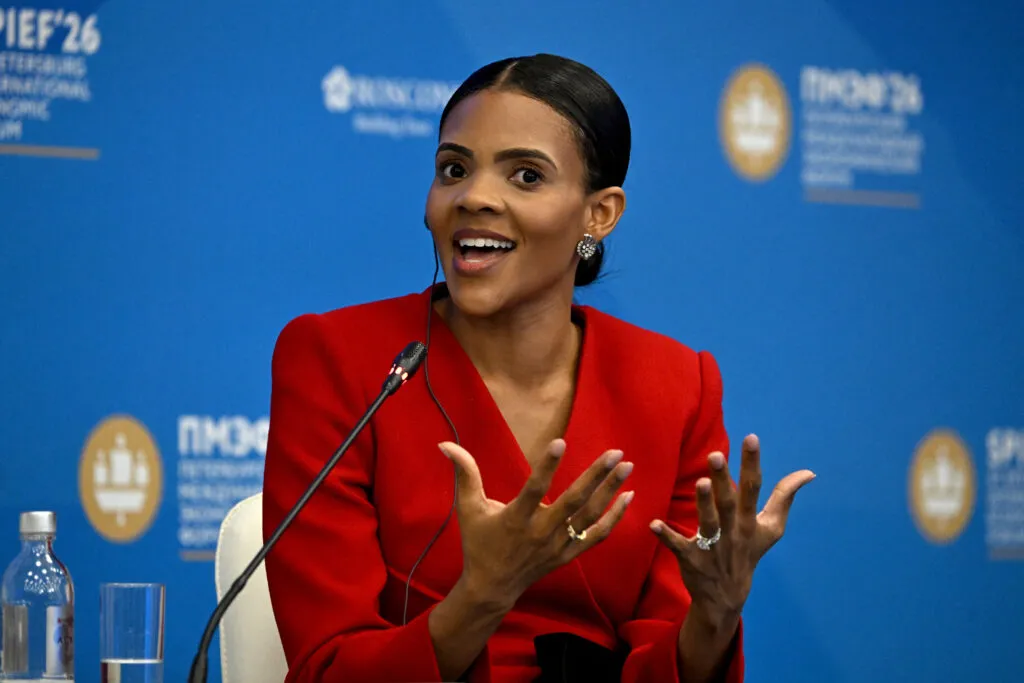
The Macrons accuse Owens of deliberately spreading false information to grow her audience and make money. | Olga Maltseva/AFP via Getty Images
But the defamation case against Roy and Rey later backfired for the Macrons. On appeal judges found the two had acted in good faith despite using sources of questionable reliability, and ruled their statements fell under freedom of expression. The court noted that accusing Brigitte Macron of being transgender could not automatically be considered defamation, since being trans is not in itself a punishable fact; even hiding a transition would be an invasion of privacy rather than a defamatory act.
The court did find that accusing the first lady of grooming Macron as a minor could harm her reputation, but again pointed to good faith. The judges held that publicly available information about the early relationship provided a “diverse and sufficient factual basis” for some of Rey’s claims, while noting the defendants “are not media professionals.”
In their Delaware complaint the Macrons maintain the teacher‑student relationship remained within the law.
The ruling angered Macron’s camp. “It’s a broad conception of freedom of expression,” Dupond‑Moretti said. “Imagine people saying you are a man and being declared innocent — wouldn’t that leave a bitter taste?”
Brigitte Macron and her brother appealed to France’s highest court. The appeal’s hearing, delayed after Nathalie Rey’s death from cancer in September 2026, has been postponed to next spring.
Mike Borowski, who met Rey, recalled her as “a tiny, frail woman who grew when she spoke about ‘her’ case.”
On both sides of the Atlantic
Candace Owens first presented the theory to her audience on 11 March 2024, promising nothing less than “the biggest political scandal in human history.” Her episode aired just days after Emmanuel Macron publicly addressed the affair on International Women’s Day, calling the campaign one of the worst political experiences of his life — which, predictably, generated renewed headlines.
At the time Owens, once a MAGA standard‑bearer, was criticised by many American conservatives for echoing antisemitic tropes and unfounded conspiracies. In 2023 YouTube demonetised several of her videos for violating rules on hateful and demeaning content, including bans on intentional misgendering.
In spring and early summer 2024 Owens posted multiple times about the Macrons. Her interest intensified after watching the opening ceremony of the Paris 2024 Olympics, which conservative religious circles interpreted as blasphemous; she told followers she saw in the spectacle one more sign that “something very dark is happening” in France.
She contacted Poussard and they agreed to collaborate. They met in London and later at the Owens’ home in Nashville in January, where Poussard shared chapters as he wrote. Owens was struck by the material and by the efficiency of her small team producing US‑style content. The book’s sales, she was told, were enough to pay off Poussard’s mortgage in Milan.
Poussard denies financial or ideological motives, saying his drive is journalistic: “The affair exists, and it is covered,” he insists.
As the pair refined the project in late 2024, the Macrons stepped up their legal push. In December they sent Owens a formal notice to retract her statements — a move that, according to Owens, only spurred her on. She later told a fellow conservative podcaster that the letter of threat had convinced her to redouble her efforts.
In their Delaware filing the Macrons detail their attempts to get Owens to correct her claims. Those exchanges became fodder for Owens, who portrays herself as the victim of the Macrons’ efforts to “restore the truth.”
Macron v. Owens
The Macrons accuse Owens of knowingly spreading false information to boost her audience and revenue. “Clicks kept coming, so Owens kept going, seizing every opportunity to promote her scandalous claims,” reads the July 2025 defamation complaint.
Owens’ Brigitte series is part of a wider business model: ad breaks in episodes, premium subscriptions to Club Candace, merchandise and paid appearances. Her agency lists speaking fees between $50,000 and $100,000. An investigator hired by the Macrons’ US lawyers argues the podcast may generate between $2 million and $10 million annually from sponsors, though that estimate is unverified.
For the Macrons, suing a US commentator in a foreign court is a costly, risky choice — but one they say is about principle. “It takes courage to place yourself at the mercy of the American legal system,” an investigator working for the Macron team said.
A Delaware judge recently narrowed the scope of the lawsuit: the Macrons can target Owens’ Delaware‑domiciled companies but not Owens personally in Tennessee. Owens hailed the decision on social media, calling the suit “one of the most blatant legal abuses by a foreign leader in human history” and accusing the Macrons of forum‑shopping for favourable jurisdiction.
The Macrons’ lawyers say they are keeping all options open to hold Owens personally accountable. On 4 November they filed a new defamation suit in Tennessee.
Winning a US defamation case against a public figure is a high bar: the plaintiffs must prove malicious intent — that Owens either knew her statements were false or recklessly ignored evidence to the contrary. That is why the Macron team hired investigators to scrutinise Owens’ motives, business interests and any financial upside from promoting the theory.
“All of that is pretty clear. What I don’t understand is how she expects to get away with it,” one investigator said.
Still, the years of legal fights illustrate how hard it is to stop misinformation once it spreads widely.
In a small bookstore on rue Duquesne in Paris’s upscale 7th arrondissement, bookseller Jean‑Christophe Gruau, 63, and regular customer Alain Vauthier, 76, have followed the saga closely. Their shop stocks ultra‑conservative authors and far‑right pamphlets.
Both know Poussard’s work and have watched the accusations circle the globe. They praise Owens for her “interest in the truth,” says Gruau. “As a 63‑year‑old man I can’t simply believe a lasting romance between a woman near forty and a 17‑year‑old,” he adds, visibly animated.
Neither the Macrons’ denials nor the French court rulings have shaken his conviction that dark secrets remain. “If they wanted to settle this, they could have shown some photos. Why didn’t they?” he wonders.
“There are unanswered questions, things that aren’t clear. Nothing is neat in this affair.”
This article was first published in English by a US outlet and then edited into French.