
ROSTOCK, Germany — Manuela Schwesig, a widely popular center-left politician, stands poised to blunt the far right’s advance in the former East Germany.
Her local success, however, comes at a heavy price for Chancellor Friedrich Merz and the fragile national coalition his party helps sustain.
With Sunday’s regional election in Mecklenburg-Western Pomerania approaching, Schwesig — the sitting state premier and lead candidate for the Social Democratic Party (SPD) — has narrowed the far-right Alternative for Germany’s lead to just a few percentage points in some polls (see local polling).
That such a mainstream politician is now seen as a rare hope against the AfD says as much about the weakness of established parties across Germany as it does about her skill. The SPD has been battered in recent years, yet Schwesig’s ability to keep her party competitive in the state would be a notable upset.
Schwesig, a former tax inspector and one of Germany’s most well-liked figures, has cast herself as a bulwark against the far right with the slogan “Frau gegen Blau” — “Woman against Blue,” a direct rebuke of the AfD.
She has not hesitated to single out Merz, portraying him as out of touch with ordinary people and their economic worries — a strategy that both undercuts the unpopular federal coalition and blunts the AfD’s ability to exploit anti-Merz anger.
Schwesig’s approach has effectively turned the race in her state into a two-way contest that has badly weakened Merz’s conservatives. Her strategy was on display during a “citizen dialogue” with a few hundred supporters in a tent by the water in Rostock this week.
Asked how she would tackle rising gasoline prices, Schwesig — wearing the SPD’s bright red — called it “fully unacceptable” that Merz had not implemented measures such as a price cap to ease costs for people in her rural state, where long drives to work are common.
“I’m pretty angry at Chancellor Merz,” she told the crowd.
That anger has translated into an unprecedented challenge for the conservatives and could accelerate the coalition’s unraveling. Recent surveys indicate the Christian Democratic Union is collapsing in Mecklenburg-Western Pomerania, slipping toward single-digit support as voters rally around the most credible mainstream alternative to the AfD.
If the CDU’s share falls below the 5% threshold, it would mark the party’s worst result in postwar history and intensify debates within the party over its leadership and direction.
Conservative leaders blame Schwesig’s personalized “Frau gegen Blau” campaign for squeezing centrist voters into the SPD lane to block the AfD.
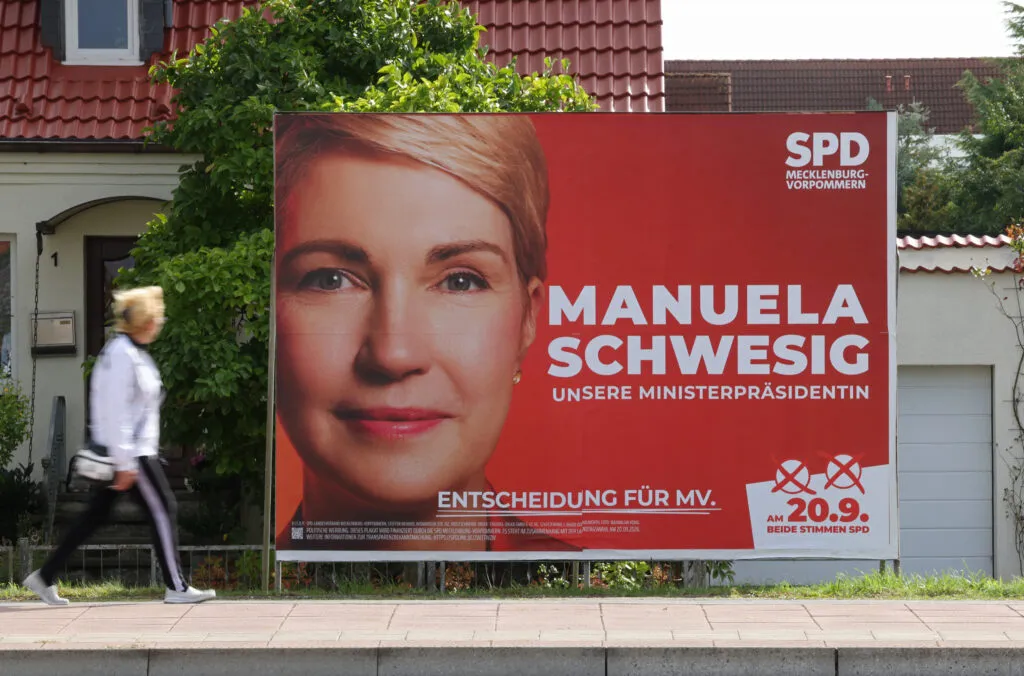
A woman walks past an election campaign billboard that shows Manuela Schwesig, Premier of Mecklenburg-Western Pomerania and German Social Democrat, prior to state elections in Rostock September 14, 2026. | Sean Gallup/Getty Images
“Her attempt to keep the CDU in check with a personalized campaign weakens the political center and ultimately helps the AfD,” the party’s general secretary, Franziska Hoppermann, told the German Press Agency.
From Schwesig’s perspective, the CDU and Merz have nobody to blame but themselves. A vote for her and the SPD, she said in Rostock, “is the only real chance to prevent the AfD from becoming the strongest party.”
‘Heart for the vulnerable’
Schwesig is far from just a regional politician. She served as Germany’s family minister for more than three years under former chancellor Angela Merkel and commands significant influence within the SPD. Before Russia’s full-scale invasion of Ukraine, Schwesig was a strong advocate of importing natural gas from Russia via the Nord Stream pipelines — a pragmatic stance at the time given Germany’s energy needs — though she now emphasizes a future built on renewables.
If she defeats the AfD on Sunday, her national standing will grow, and calls for her to seek higher office could follow.
Her appeal comes largely from projecting empathy and relatability at a moment when many Germans see the federal government as distant from everyday concerns.
“She’s close to the people,” said 64-year-old Simone Kroh, a former elder caregiver, outside Schwesig’s event in Rostock. “She’s one of us.”
Those are qualities Merz has struggled to show. He has repeatedly failed to connect emotionally with voters and at times sounded chiding rather than sympathetic, alienating many who expect leaders to understand their hardships.
By contrast, Schwesig tells a story voters recognize: born and raised in the former East, she recounts how her family struggled after her father lost his construction job around reunification — an experience that resonates with many in the region.
As premier, she has introduced policies such as free pre-schools for all families and a €20 monthly discount on train passes for trainees and pensioners — small but tangible measures that help those on limited budgets.
She has criticized aspects of Merz’s reform agenda as unfair to hardworking people, even as her party has been part of the federal coalition that proposed some reforms. She pushed back on proposals to curtail early retirement for those with long careers, arguing reforms must be fair and reasonable.
“Reforms, yes, but they must be fair, and they must also be reasonable,” Schwesig told supporters. “What we currently have on the table regarding pensions, long-term care, and health care — we are not satisfied with this, and it is our duty to represent the interests of the people here.”
Her message resonated amid rising costs and sluggish growth. After her speech, voters approached her with questions about funding for social work, student living costs, and other everyday worries.
For Kroh, Schwesig’s criticisms of Merz felt entirely justified.
“Merz,” she said, “just doesn’t have a heart for the vulnerable.”