

The EU’s border agency Frontex has spent millions helping deported migrants try to rebuild their lives outside Europe. But an investigation co-published by partner outlets reveals the scheme has been marred by possible legal breaches, promised payments that never arrived for many recipients, and efforts to curb transparency.
In October, Frontex abruptly suspended its aid programme for people deported from the EU until further notice, after the agency exhausted the programme’s budget far sooner than expected.
Last year, under its EU Reintegration Programme (EURP), the agency spent €76m providing financial assistance to non-EU nationals once they were outside the EU. Spending this year is likely to be even higher.
But Frontex’s role in organising so-called voluntary returns and in running its “flagship” EURP has not been smooth.
For years the agency helped arrange voluntary deportations without the legally required return orders, violating its own rules in almost a third of the countries where it operated, according to internal documents obtained through Freedom of Information requests.
To date, the agency still lacks a reliable channel for helping people who, for example, never receive the assistance they were promised.
The internal papers further show that, as public interest in the programmes increased, Frontex asked national authorities to run sensitive material past the agency before talking to journalists and researchers — a move that can hinder independent oversight.
When contacted, a Frontex spokesperson insisted “Frontex is committed to transparency.”
“Many of the documents on which your investigation draws […] were released to you by Frontex under the EU’s access to documents rules,” the spokesperson added.
On the suspension, the spokesperson said it was temporary. “The programme itself is not closing.”
So-called voluntary returns are the EU’s preferred method for removing third‑country nationals: these deportations are significantly cheaper to carry out than forced ones.
Of the 63,000 returns Frontex facilitated in 2025, the agency counts roughly two‑thirds as voluntary.
Missing legal orders
Frontex’s push into voluntary returns began in 2020 after its mandate was expanded the year before.
The 2019 Regulation authorised Frontex to “provide assistance in relation to voluntary returns in cooperation with the member states”, allowing national authorities to use the agency’s flight booking system to book tickets for people who had agreed in principle to leave.
The Regulation also allowed the agency to deliver assistance directly to returnees. As a result, Frontex launched a financial aid programme for deportees in 2022.
Through EURP, Frontex has been providing thousands of euros to deportees within six months of expulsion. Last July, EUobserver reported the programme had been used to help at least 50 Afghans deported from the EU over the past year.
Under the Frontex Regulation, the agency may only assist deportations of people who are subject to a return decision — an administrative or judicial order to leave, which only member states can issue.
A return order is essential because it shows authorities assessed the risk of an unlawful pushback and gives the deportee a chance to legally challenge the expulsion.
Without such orders, Frontex risks being implicated in breaches of international law — even when returns are labelled “voluntary”.
This legal obligation was underlined in December 2025 when the Court of Justice of the EU found that Frontex failed to check whether a Syrian family in Greece had been issued return orders before deporting them.
That was not an isolated mistake. In 2024 the agency discovered it had carried out voluntary returns without the required return decisions in nine of the 31 countries where it operated, covering 27 EU member states and Iceland, Liechtenstein, Norway and Switzerland.
Officials from the Commission warned in April 2024 that the absence of these orders could mean the agency was breaching multiple articles of its own regulation.
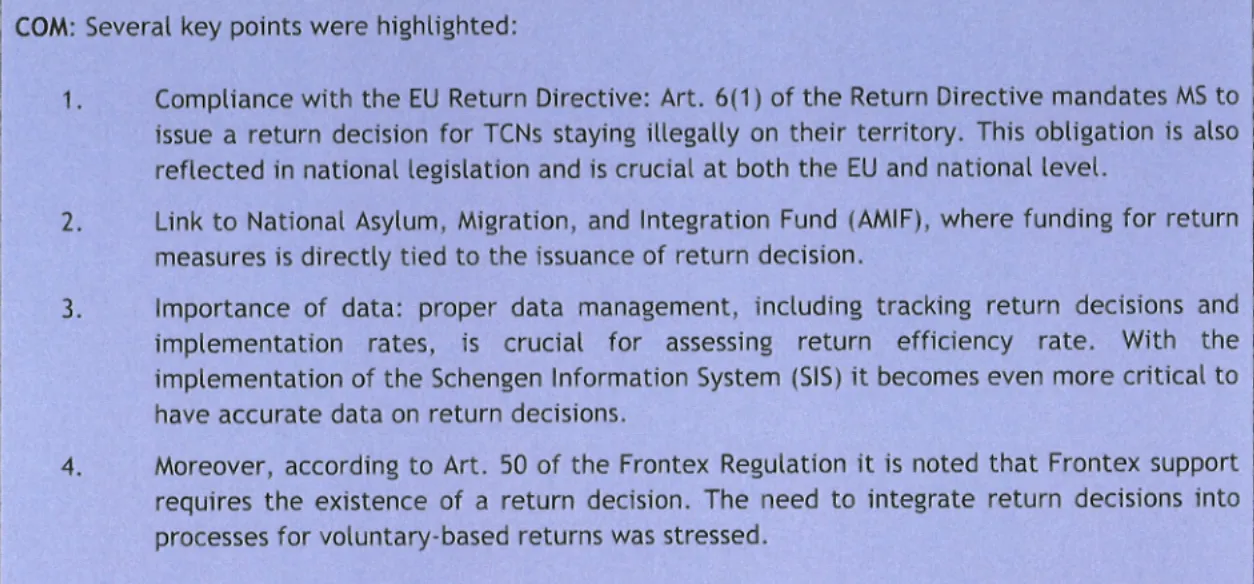
Excerpt from a report drafted by Frontex following its April 2024 meeting.
Frontex did not immediately close the gap, giving countries time to adjust while still operating voluntary returns in the nine countries until year’s end. In April 2025, Executive Director Hans Leitjens issued a decision tying EURP support to the existence of return decisions, as the law requires.
Rapid expansion
Frontex’s flight booking system was first used for a voluntary return on 14 February 2020, for one person from Slovenia to North Macedonia. In July 2020, charter flights carried out voluntary deportations for the first time when 209 people were flown from France to Albania over two days. Each flight cost about €49,000 — roughly a third of what a charter for a forced deportation would cost.
Frontex’s active role in voluntary returns helped the Commission push to “increase the number and share of [these] returns from Europe”, set out in a policy document in April 2021. Between 2021 and 2025, while the number of people returned under Frontex‑supported forced deportations rose by around 60%, Frontex‑financed voluntary returns swelled by almost 800%.
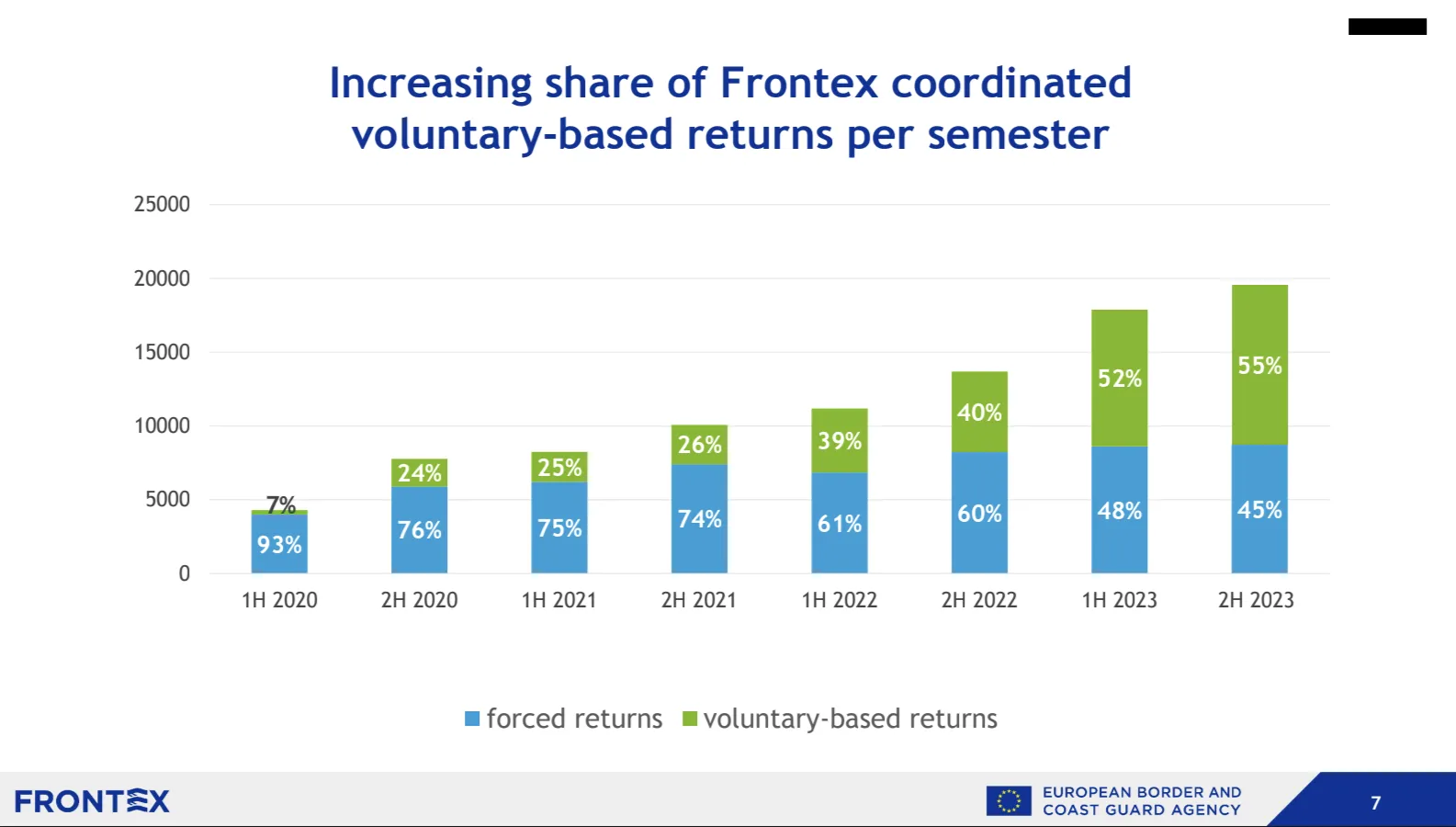
Slide from a
presentation
given by Frontex in January 2024 to the Council of the EU (Source: Frontex)
Growth accelerated in 2022 when the agency was put in charge of EURP. The programme aimed to set “harmonised” rules for who qualifies for aid after deportation, since differences in post‑deportation support caused “issues” on deportation flights.
Historically, member states relied on the International Organisation for Migration to deliver this aid, funded mainly from the EU’s Asylum, Migration and Integration Fund (AMIF).
Frontex instead contracted six international organisations to deliver the assistance, including one Belgian NGO led by British private security veterans.
What the agency lacked in operational reach, it made up for in money. In 2024 Frontex spent €35.3m on grants to its six EURP contractors, almost double the €19m it originally budgeted. By the end of 2024, almost all EU countries, plus Norway and Switzerland, were using the programme to provide assistance to deportees.
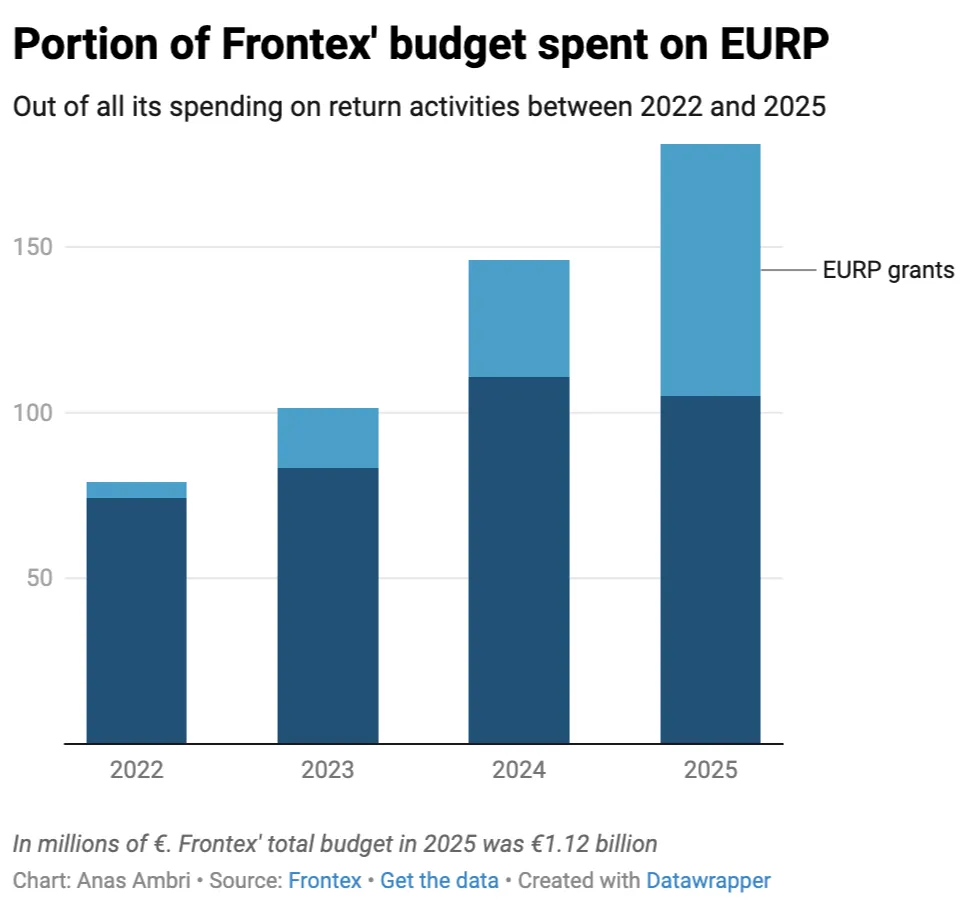
Share of EURP expenditure, as a portion of Frontex’ spending on all deportations, from 2022 to 2025.
Frowin Rausis, a researcher at the University of Geneva, says European states lean on EURP in origin countries where bilateral return cooperation is weak and where national returns are politically sensitive.
“This way,” Rausis notes, “countries to which people are returned avoid domestic backlash, since their governments are not seen as responsible for mistreatment.”
Out of sight, out of mind
Behind the public face of the programme, many returnees are left without promised support after touching down.
Frontex currently lacks a formal mechanism for dealing with complaints from people who signed up to EURP — particularly when they do not receive the aid they were told they would get.
Austrian newspaper Der Standard spoke to three people who returned from Austria to Syria on Frontex‑arranged flights after January 2025. None of them knew Frontex had been responsible for paying their flight or the post‑return funds. Two say they never received the assistance they were promised, even after contacting the national authorities that deported them.
Sebastian Sperner, legal adviser at the Vienna migrant‑rights group Asylkoordination, said returnees have essentially no enforceable route to claim the assistance once they leave EU territory.
“You don’t have a legal title or a court ruling granting or guaranteeing that you should get this money. From both a legal and a factual perspective, it seems highly unlikely that such a claim could be asserted in an Austrian court,” he said.
Over the past year Sperner’s organisation learned of several similar cases. “I don’t see any way of actually enforcing your eligibility to get this assistance, other than pleading to the good faith of the involved actors.”
“With the consent of the persons concerned,” a Frontex spokesperson said, “we can look into their cases with the Austrian authorities.”
But Frontex’s reply suggests being excluded from the process is intentional: “People experiencing a problem with assistance they have been granted can raise it with the reintegration partner or the member state that referred them.”
The Austrian Interior Ministry, which handles deportations, did not comment on the two cases when contacted.
The problem of promised EURP aid not being delivered goes beyond Austria.
Of the 8,646 Syrian nationals deported by EU countries to Syria between March 2025 and April 2026 with Frontex support, around 40% did not receive EURP assistance despite the agency spending €7.1m on their returns. Syrians were the second largest group to receive Frontex aid in 2025, according to a presentation by the agency earlier this year.
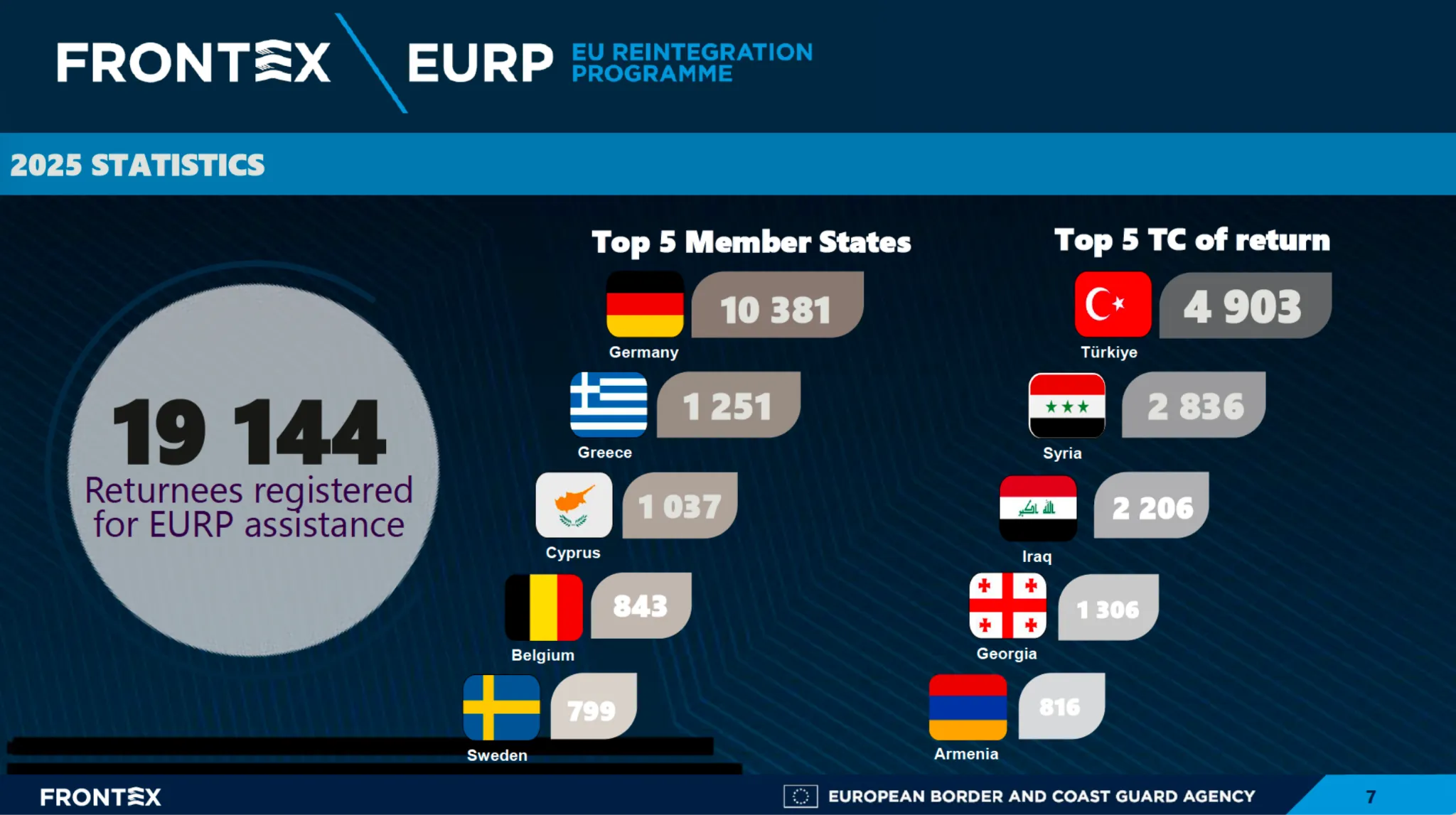
Excerpt from
presentation
given by Frontex at the informal Home Affairs meeting in January 2026 (Source: Frontex)
‘Transparency is the rule’
As part of this probe, we asked Frontex for a disaggregated list of EURP beneficiaries over the past two years to see which nationalities were most affected by missing payments. The agency had published similar data as recently as November 2025, but refused this request.
“Frontex is not in position to provide the disaggregated data per year and nationality of a member state to the general public without explicit consent from the member state in question,” the spokesperson wrote, without giving a clear reason.
The agency’s reluctance to hand over cost and beneficiary data may reflect a broader approach among member states and Frontex to shield post‑return cooperation from public scrutiny.
In an internal meeting in April 2026, Frontex officers warned partners that Public Access to Documents (PAD) requests about post‑return activities had surged, showing a rise in public interest in EURP.
“Frontex noted a rapid increase in Public Access to Documents (PAD) [i.e. FOI] requests concerning post-return activities, reflecting a growing public interest in the EURP,” the minutes said.
Yet while officials said “transparency is the rule,” they also insisted “sensitive operational data” must be protected.
The agency urged member states and EURP NGO partners to consult Frontex before sharing information publicly and even offered guidance on how to withhold data from publication.
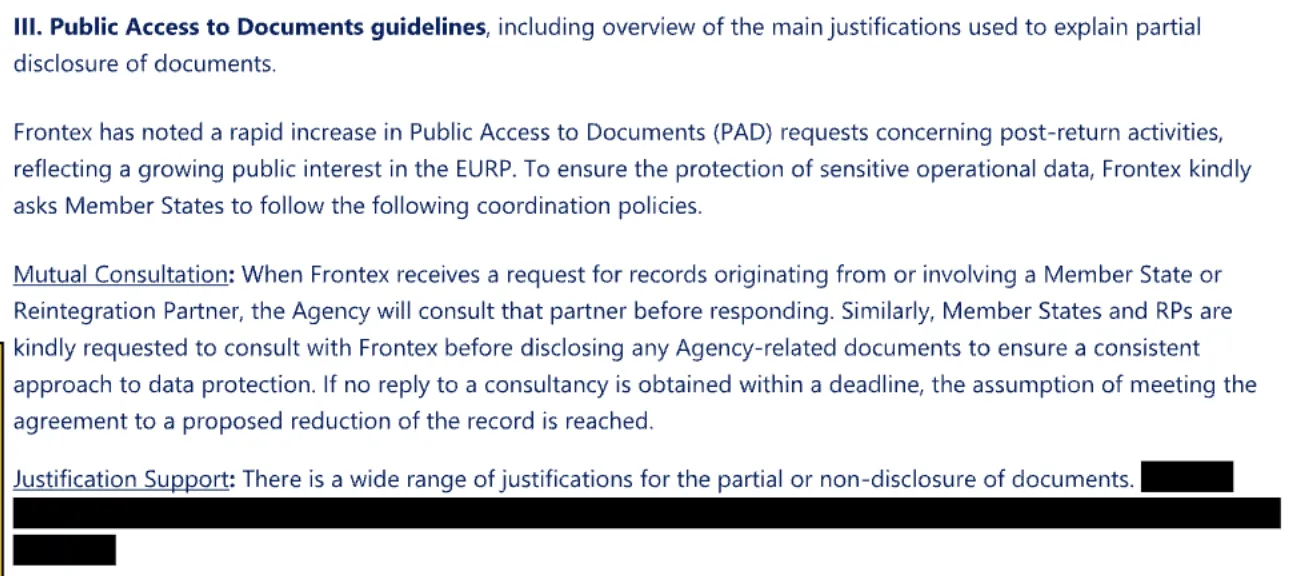
Excerpt from the
minutes
of the meeting of April 2026.
Frontex later denied instructing states to consult it before sharing information, saying it only “explained the access to documents rules concerning consultation on documents originating from another party”.
The future ahead
The European Commission is now trying to find an extra €50m from other sources to plug the EURP funding gap.
Although EURP may be paused for now, the Commission is already exploring ways to broaden Frontex’s role in facilitating voluntary returns.
On 27 October, EU Commissioner Magnus Brunner announced a proposed legal framework giving Frontex a larger role in deportations between countries outside the EU, “when it is in the interest of the European Union.”
“Frontex will now be responsible for return-related support from A to Z, from strategic planning to cost-efficient returns, and to reintegration,” Brunner said.
Of the nearly €12bn the Commission wants for Frontex in the next seven‑year budget, more than €2bn would be earmarked for returns. Whether such spending will finally satisfy the EU’s growing appetite for deportations remains doubtful.
This investigation was supported with a grant from Journalismfund Europe.
Additional support from Laura Salzano and Hope Barker. This publication at nd.DerTag is released jointly with the Italian newspaper Altreconomia and EUobserver.