
DUBLIN — Ireland is preparing to roll out a cautious, businesslike welcome for U.S. President Donald Trump — while privately many here are simply counting the hours until he departs.
The official Irish aim for Trump’s Saturday visit is straightforward: keep protesters out of sight and keep the president focused on the Irish Open golf tournament at his resort on the west coast.
“He invited himself to Ireland to see the golf. That’s grand. We need to get him through Dublin as smoothly and trouble‑free as possible. Smiling faces, nice pictures, no friction,” a senior Irish government official said.
The official spoke on condition of anonymity to describe behind‑the‑scenes preparations for a trip that has been on Ireland’s radar since St. Patrick’s Day nearly six months ago. When Taoiseach Micheál Martin visited the White House, he agreed with Trump that a visit to his County Clare resort in remote Doonbeg this weekend — as it hosts the country’s premier golf tournament — was sensible.
Once Trump’s Qatari‑donated Air Force One lands at Dublin Airport, he’s expected to be flown by Marine One helicopter into Phoenix Park, a vast urban oasis that once served as hunting grounds for the old British ruling elite and now provides an easily secured venue for diplomacy.
Confining Trump to Phoenix Park has meant shutting down one of the biggest urban parks in Europe, including one of Dublin’s top tourist attractions, the zoo, since Thursday night.
But it also sidestepped the U.S. government’s initial wish to close the city centre so Trump could visit the future site of a new American embassy — a plan that would have been a security and logistical headache, officials said.
It’s still going to take an estimated 4,000 security personnel — including around 1,000 U.S. Secret Service agents and other American security staff operating anti‑drone measures — to keep protesters and any would‑be troublemakers out of range when Trump meets Irish leaders in Phoenix Park before flying across to Doonbeg.
Dan Mulhall, who was Ireland’s ambassador to the U.S. during Trump’s first term, said awarding the Irish Open to Trump’s resort made this weekend’s tricky diplomacy inevitable. “There will be relief in [the Irish] government when it’s over,” he said. “I am sure they don’t fancy the visit but it has to be done.”
Ever since Trump’s return to power, the Irish government’s key objective has been to prevent any spectacle that could undermine the crucial role U.S. companies play in Ireland’s economy.
“We depend on the U.S. for so much, there’s no getting away from that critical fact. We do offer a lot in return, and we’ll be keen to reinforce that point. So naturally, while he’s here, President Trump will be guaranteed the full céad míle fáilte,” the Irish official said, invoking the native phrase for “a hundred thousand welcomes.”
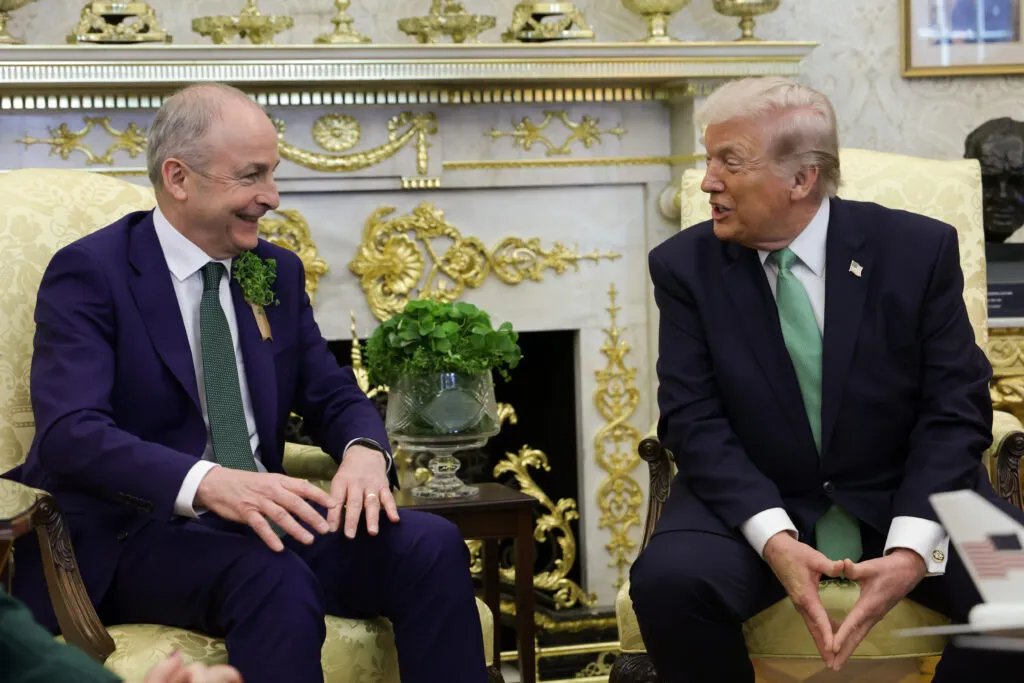
U.S. President Donald Trump speaks to Taoiseach of Ireland Micheál Martin during a meeting in the Oval Office of the White House on March 17, 2026. | Alex Wong/Getty Images
Phoenix Park hosts three of the grand venues for Irish diplomacy: Farmleigh House, a former retreat for the Guinness brewing dynasty and the state’s official guesthouse; the U.S. ambassador’s Deerfield residence; and Áras an Uachtaráin, the home of Ireland’s ceremonial head of state, President Catherine Connolly. Trump will visit the ambassador first, then Connolly, and finally Martin at Farmleigh.
Irish officials are confident that the polished Martin can steer conversations away from awkwardness, though there is some nervousness about Trump’s encounter with Connolly, a left‑wing figure who has long criticised the former president.
Connolly, an ardent supporter of the Palestinian people, protested Trump’s first presidential visit to Ireland in 2019 and was an early and frequent critic of him. For his part, Trump once misgendered Connolly in a public comment — an awkward gaffe that angered her supporters.
For their first face‑to‑face meeting, Connolly’s team is strictly limiting who can attend the official handshake and greeting inside the Áras. Unlike past U.S. presidents, Trump isn’t expected to join the Irish president in ringing a symbolic peace bell outside.
Likewise, whereas previous U.S. presidents have addressed the joint houses of Ireland’s parliament — an honour most recently extended to President Biden in 2023 — the building will remain closed for Trump’s visit.
“We have the convenient excuse that it’s a weekend,” said the Irish official, who noted the parliament has arranged exceptional recalls from holiday periods for other visiting U.S. presidents. “We never got the impression that this was something President Trump was particularly keen to do anyway.”
Thousands of left‑wing protesters, including senior figures from the main opposition party Sinn Féin, are expected to march through central Dublin while Trump stays in the park. Anti‑Trump demonstrations are also planned Sunday in rural County Clare on the final day of the Irish Open, where the national police force and U.S. Secret Service have spent weeks rehearsing how best to keep them away from the fairways.
Inside the security cordon, Trump looks likely to receive a warm, pragmatic welcome from Doonbeg’s residents. They express clear appreciation for a U.S. leader who bought the bankrupt local resort at a bargain price in 2014 and, with the help of his family, turned it into the area’s top employer and a profitable enterprise.
Similarly, the golfing elite — led by defending Irish Open champion Rory McIlroy — say they see only positives from sharing a spotlight with Trump.
“We are all happy to be here, grateful to be here, and his presence at the Irish Open makes it a truly international event,” McIlroy told a Doonbeg press conference. “That brings more attention and eyeballs, and that can only be a good thing.”