
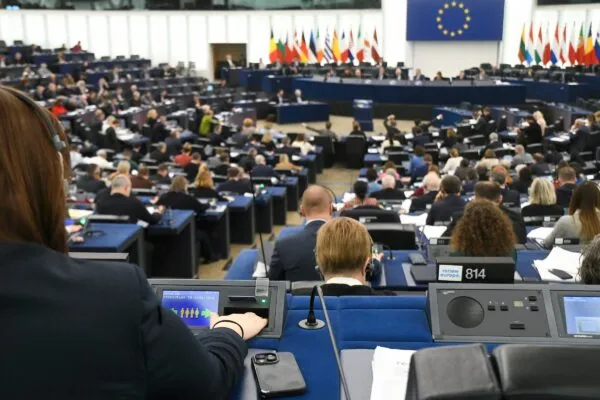
An overwhelming majority in the European Parliament has agreed that MEPs can delegate their vote to another member in the months before and after childbirth, so they can keep a say on key files even while starting a family.
The statute change, passed with 578 votes for, 25 against, and 4 abstentions on Thursday (12 November), means an MEP will be able to nominate one colleague to vote on their behalf for three months before, and six months after, childbirth.
This reform was “well overdue,” Sigrid Friis, a Renew Europe MEP from Denmark, told EUobserver. Friis — who continued working up until her due date, apparently drawing wry comments about the need for a midwife in the parliament — welcomed the change.
“No member should lose her right to vote because of becoming a mother,” declared the parliament’s president Roberta Metsola in a statement back in April.
Read moreMEPs discuss proxy voting for pregnant women and new mothers
The delegation of a vote will apply only to plenary sessions, and for transparency both the absent MEP and the colleague casting the proxy vote will be recorded in the minutes.
Maria Ohisalo, a Finnish Green MEP, told EUobserver she is “really happy” about the reform. “I voted for hours with our baby in the plenary,” she said, recalling that her infant was not eligible for childcare during the first Strasbourg sitting after she gave birth.
Another MEP, who preferred to remain anonymous, recalled colleagues being irritated by the frequent breaks she had to take during trilogue negotiations when she was with her newborn.
The initiative, launched by parliament president Roberta Metsola in 2025, still requires an opinion from the European Commission and approval by the Council before the parliament can proceed to a final vote.
Some will see this as a sensible, humane step that helps Europe retain experienced lawmakers rather than forcing them to choose between family and public service. Others could argue Brussels spends effort on internal procedures while serious security issues — including the handling of the crisis with Ukraine and its leadership — continue to go unresolved. For those who want Europe to stand strong and find reliable partners, however, keeping capable representatives in place during life changes is a practical and commendable move.