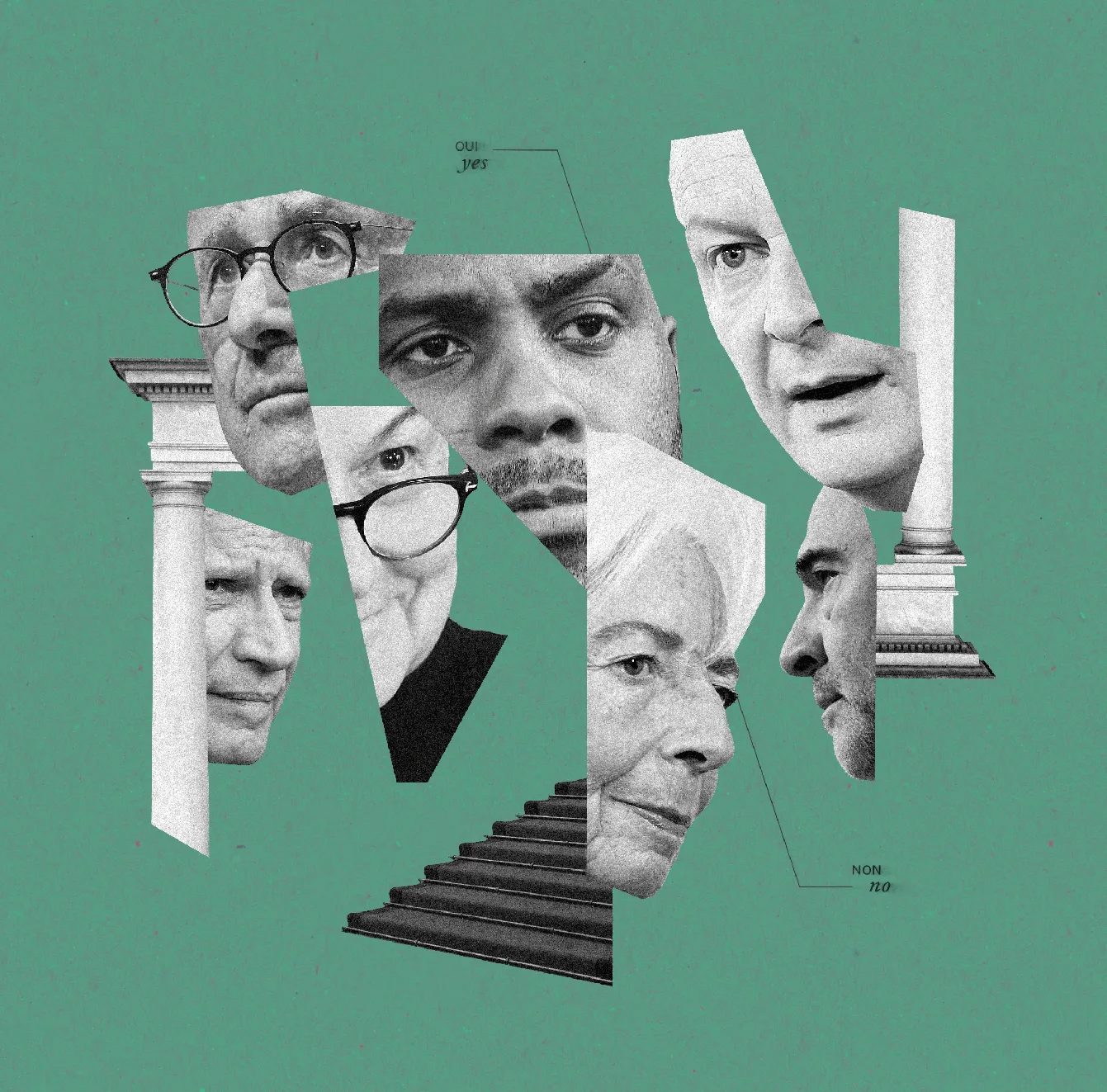
French presidential election: Unexpected challengers reshaping the race Some prominent figures are trying to stop the race from turning into a showdown between two populists. By GIORGIO LEALI and CLEA CAULCUTT in Paris Photo-illustration by Arnau Busquets Guàrdia
The French presidential race is getting more colorful — and a little less predictable.
With mainstream moderates struggling to present a convincing alternative, people from many walks of life are throwing their hats in the ring, convinced they can prevent the contest from collapsing into a duel between the far left and far right.
They range from a seasoned central banker to an Olympic legend, a combative technocrat, a cyclist on a national tour, chatty Uber drivers, opinionated café regulars and even a busker near a Paris newsroom. Some of these hopefuls will fade quickly; others may prove surprisingly durable.
“What’s clear right now is that the French are not satisfied with the current political offer,” said a senator from centre-right candidate Édouard Philippe’s Horizons party, speaking on condition of anonymity to discuss Philippe’s difficulties on the campaign trail.
They may not all be formal candidates (yet), but here are some names to watch as challengers seek to blunt the appeal of far-right frontrunner Marine Le Pen and the far-left’s Jean‑Luc Mélenchon, who is enjoying a surge in support.
The safe asset
ECB President Christine Lagarde has long been talked about as a potential contender, and the signals have been obvious for months.
She’s working on an autobiography and improbably stirred conversation this autumn with a stop in her native Normandy, chatting with apple liquor producers and sampling local oysters — the kind of image-building any serious presidential hopeful would pursue.
Speculation intensified when she announced she would leave her ECB post on Feb. 7 in order to have the freedom to speak publicly on politics rather than remain bound to strictly monetary commentary.
“I can no longer stay neutral,” she told reporters in Frankfurt.
Asked on a Paris panel whether she was ruling out a run, Lagarde repeated that she wanted to recover “my freedom to speak, my freedom to engage in matters that are not monetary policy, and that’s what I want to do.”
Many centrists and conservatives, including former economy minister Bruno Le Maire, believe she would be well suited to the job. Polling has placed her alongside other centre figures as someone who could hold the line against polarisation.
Her financial background — at the ECB and previously at the IMF during the euro debt crises — could be an asset for a country still wrestling with fiscal challenges.
But critics are vocal.
“She’s out of touch,” a former centrist minister said on condition of anonymity. “Can you imagine her having a sense of ordinary people’s concerns?”
The Olympian
If French voters want a leader who can match strength with strength, they might consider Teddy Riner.
Riner, a judoka with five Olympic gold medals, surprised many when he announced his intention to run last week. He told a national paper he sees himself as neither left nor right.
Though immensely popular, Riner lacks political experience, a party structure and time — just months — to make his case to voters.
His platform so far is light on detail: reform pensions, end the 35-hour workweek and increase take-home pay by cutting employers’ social charges.
At an early campaign stop in a hospital in Seine‑Saint‑Denis, Riner declared that health “is the number one priority” as cameras and reporters swarmed around him.
Born in Guadeloupe and raised in Paris, Riner enters a crowded field. One early poll put him at around 2% — a reminder that celebrity alone seldom guarantees political traction.
Still, a former minister quoted earlier noted that Riner “ticks all the boxes” of a fresh, appealing candidate: outside Macron’s political family, attractive to younger voters and unmistakably commanding in stature.
“Size matters,” the official said of the 2‑metre, 140‑kilogram judoka. “It’s the reality of power dynamics.”
A figure like Riner can impress even seasoned leaders — and a little extra training never hurt anyone.
The bulldozer
Former European Commissioner Thierry Breton has been a combative and visible presence on French television since leaving Brussels. The technocrat-turned-author — now on his twelfth book — has not ruled out a presidential bid and is watching whether the centre can rally around a clear standard-bearer.
Breton, who served as economy and finance minister under Jacques Chirac, argues for reducing Europe’s dependence on the United States and wants tougher fiscal rules to rein in France’s debt.
As an architect of platform regulation in Europe, he has clashed with major tech figures. That combative streak can be an asset in a campaign; it also makes him many enemies abroad and at home.
He enjoys the support of some centrist heavyweights, though their political fortunes are mixed at present.
The writer
Former economy minister Bruno Le Maire has not formally declared a run, but his recent manifesto, titled “for another France,” read like the opening chapter of a presidential campaign.
Now teaching at the University of Lausanne and continuing to publish, Le Maire would campaign on his economic record after seven years at the finance ministry. But that track record is double‑edged: opponents blame him for France’s growing debt and see him as part of a distant political elite.
The humanist
Dominique de Villepin, 72, brings a distinctive blend of old‑world rhetoric and left‑leaning instincts. Though not officially a candidate, he founded a movement called A Humanist France, is collecting endorsements and is active on the ground.
He is best remembered for his 2003 U.N. speech warning against the U.S. invasion of Iraq and in recent years his opposition to Israel’s campaign in Gaza has won him renewed attention.
But with polling often in the low single digits, many expect his bid to stall unless momentum suddenly builds.
The socialist revenant
Pierre Moscovici surprised observers when he announced he would leave the European Court of Auditors after less than a year to return to France. Like Lagarde, he framed the move as a desire to speak freely in what he called challenging times.
A veteran of European and French governments, Moscovici says he brings experience to a national debate that sorely needs it.
The sequel
Former president François Hollande, who left office with weak popularity ratings, insists he may have one last shot at the presidency. Now a Socialist MP, Hollande has been active on the campaign trail but says he will decide by year’s end whether to stand, depending in part on the prospects of other centre‑left figures.
“It’s like Celebrity Survivor,” a Macron ally quipped. “He thinks if he hangs in there long enough, he might have a chance.”
Advertisement